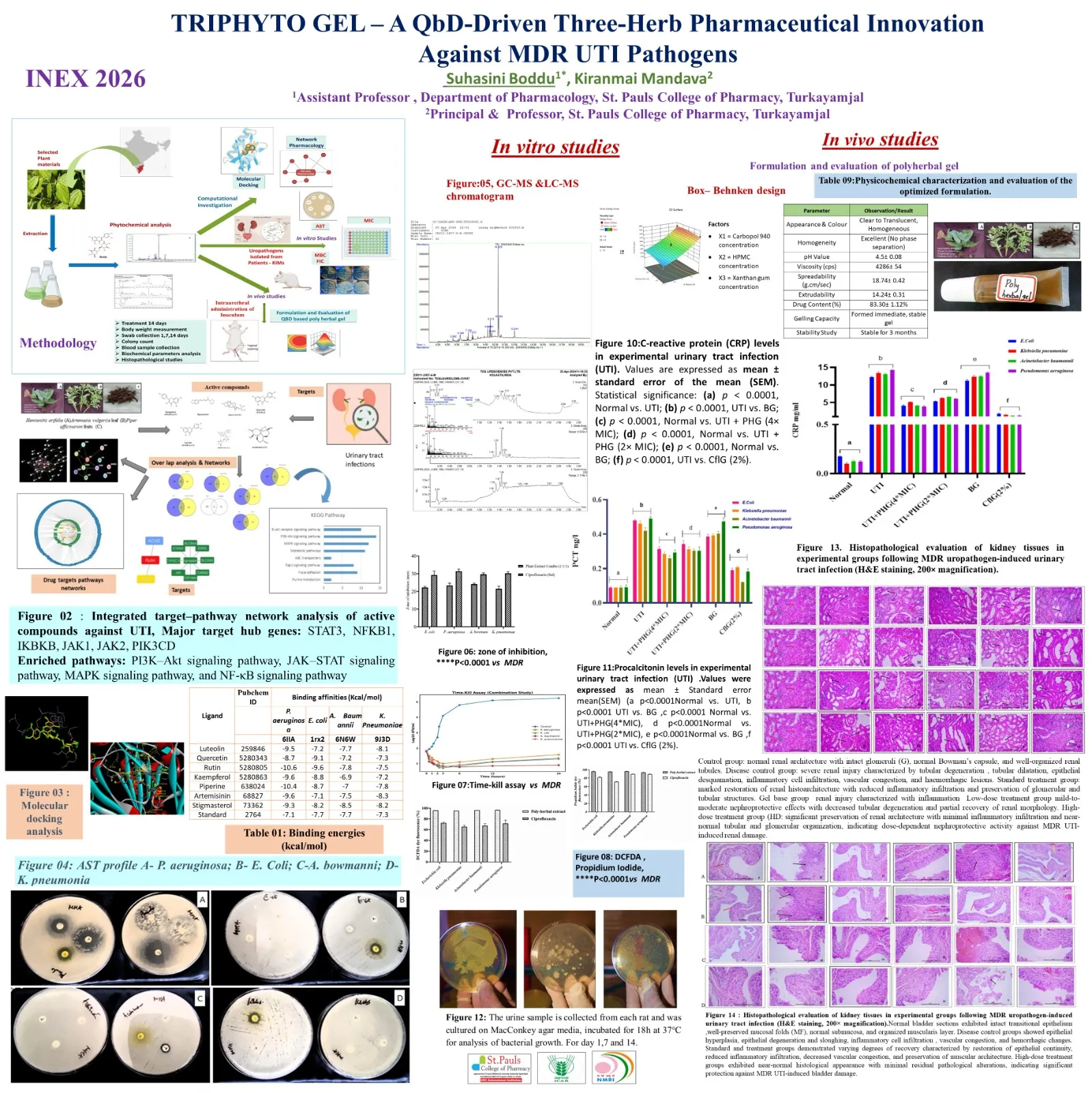
TRIPHYTO GEL – A QbD-Driven Three-Herb Pharmaceutical Innovation Against MDR UTI Pathogens
Industry 4.0polyherbal gel using three medicinal plants developed to address the growing challenge of multidrug-resistant urinary tract infections. By integrating phytochemical characterization, computational drug discovery, QbD-based formulation optimization and preclinical evaluation, we aim to transform traditional medicinal plant knowledge into a standardized, research-driven herbal healthcare product.
- Innovator(s)
- Mrs. Boddu Suhasini, Dr. Kiranmai Mandava
- Organisation
- St. Pauls College of Pharmacy
- Country
- India
- Exhibition zone
- Product Arena
- Technology Readiness Level
- TRL 4 of 9
- Edition
- INEX 2026
About this innovation
The present study aimed to design, develop and evaluate a novel polyherbal gel incorporating three medicinal plants, namely Hemionitis arifolia (HA), Artemisia vulgaris (AV) and Piper officinarum (PO), for combating multidrug-resistant (MDR) urinary tract infection (UTI) pathogens. The selected plant extracts exhibited extraction yields of 16.6%, 23.5% and 25.9%, respectively. Phytochemical characterization using GC-MS and LC-MS identified several bioactive constituents, including quercetin, kaempferol, luteolin, rutin, artemisinin, piperine and stigmasterol. Molecular docking studies demonstrated favourable binding energies for rutin (−10.6 kcal/mol) and piperine (−10.4 kcal/mol) against selected therapeutic targets, while network pharmacology identified important pathways, including PI3K–Akt, JAK–STAT, MAPK and NF-κB signalling pathways. In vitro antibacterial evaluation against four Gram-negative uropathogens, namely Escherichia coli, Pseudomonas aeruginosa, Acinetobacter baumannii and Klebsiella pneumoniae, demonstrated promising activity of the tri-herbal combination (1:1:1), with MIC values of 34.34, 19.53, 34.37 and 22.81 mg/mL, respectively, and zones of inhibition of 22.2, 23.3, 24.1 and 21.5 mm, respectively. Furthermore, the polyherbal gel was optimized using a Quality by Design (QbD) approach employing Box–Behnken experimental design. The optimized formulation exhibited a pH of 4.5 ± 0.08, viscosity of 4286 ± 54 cps, spreadability of 18.74 ± 0.42 g.cm/sec, extrudability of 14.24 ± 0.31g and drug content of 83.30 ± 1.12%, with stability maintained for three months. In vivo evaluation using an experimental UTI model in Female Wistar albino rats over 7 and 14 days demonstrated improvements in urinary bacterial burden, inflammatory markers, including C-reactive protein (CRP) and procalcitonin (PCT), and histopathological alterations in renal tissues. Collectively, these findings highlight the potential of the developed polyherbal gel as a promising plant-based formulation against MDR-associated UTIs, supporting further standardization, safety validation, translational research and future commercialization.