Keystone
Young InnovatorsKeystone works on a structure's whole life. Before building, AI tools calculate, estimate and code-check the design, recording every approval. Phase 1: that design becomes a Digital Twin. Phase 2: IoT tools pre-synced to it track construction and use, catching drift before the crack. Phase 3: a community where civil engineers shape what comes next. Fewer errors, defensible designs, safer structures. From design desk to bridge deck. Keystone. Civil engineering, finally intelligent.
- Innovator(s)
- Jayanth Reddy , Ram Charan , Rithesh Mamindlapalli
- Organisation
- Vaagdevi College of Engineering
- Country
- India
- Exhibition zone
- Product Arena
- Technology Readiness Level
- TRL 4 of 9
- Edition
- INEX 2026
About this innovation
KEYSTONE
Civil engineering, finally intelligent.
WHAT IT IS
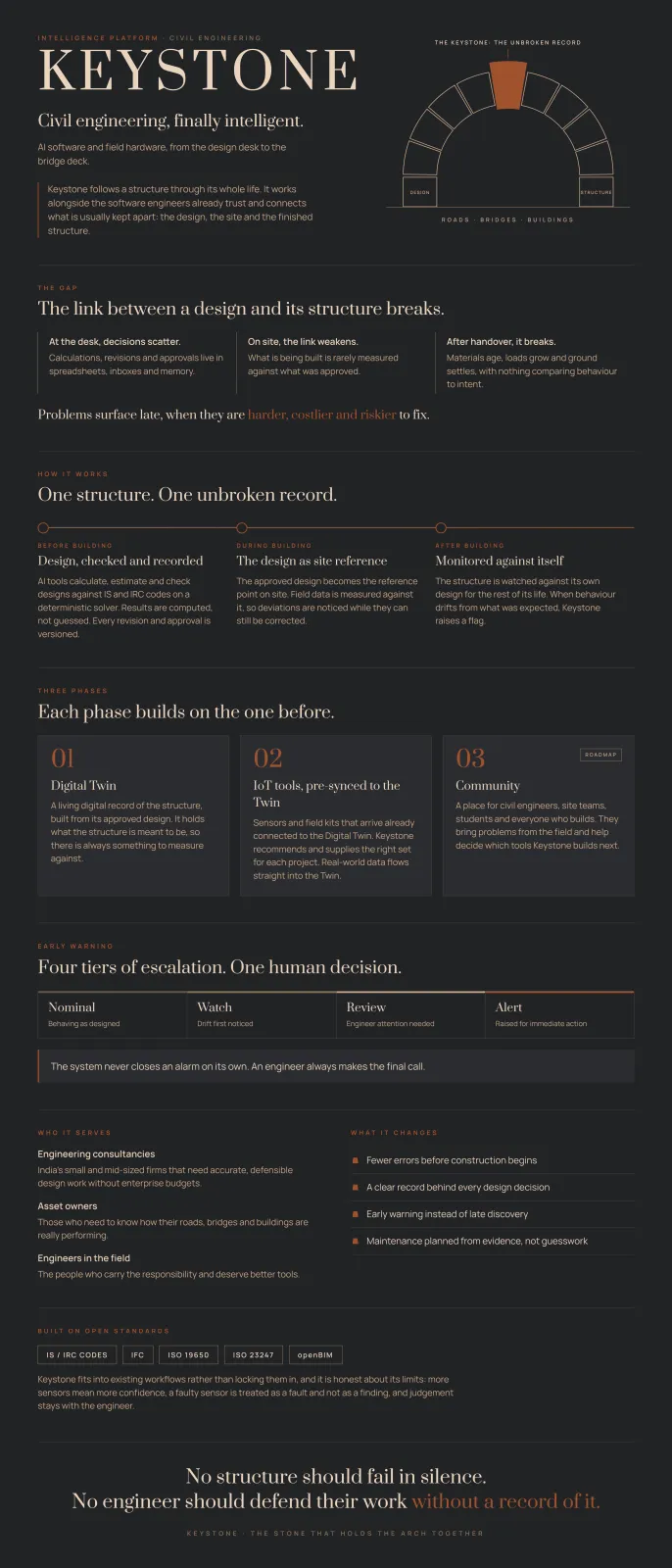
Keystone is an intelligence platform for civil engineering. It follows a structure through its whole life, from the first calculation on an engineer's desk to the years it spends carrying people, traffic and weight. It does not replace the software engineers already trust. It sits alongside it and connects what is usually kept apart: the design, the site and the finished structure.
WHY IT EXISTS
Every road, bridge and building begins as a set of decisions. Loads are calculated, quantities estimated, drawings revised and approvals signed. Today those decisions scatter across spreadsheets, inboxes and people's memories.
Once construction begins, the link between the design and the real structure weakens. Once it is complete, the link usually breaks. The structure keeps changing as materials age, loads grow and ground settles, but little compares what is happening with what was intended. Problems tend to surface late, when they are harder, costlier and riskier to fix.
Keystone exists to keep that link unbroken.
HOW IT WORKS
Before building
AI tools help engineers calculate, estimate and check designs against IS and IRC codes, using a deterministic solver so the results are computed rather than guessed. Every revision and approval is recorded, so a firm can always show what was designed, who approved it and why.
During building
The approved design becomes the reference point on site. Field data is measured against it, so deviations are noticed while they can still be corrected.
After building
The structure is monitored against its own design for the rest of its life. When behaviour begins to drift from what was expected, Keystone raises a flag in stages, from Watch to Review to Alert. The system never closes an alarm on its own. An engineer always makes the final call.
THREE PHASES
Phase 1. Digital Twin
A living digital record of the structure, built from its approved design. It holds what the structure is meant to be, so there is always something to measure against.
Phase 2. IoT tools, pre-synced to the Twin
Sensors and field kits that arrive already connected to the Digital Twin. Keystone recommends the right set for each project and supplies it, so even a small firm gets what the job needs. From the first reading, real-world data flows straight into the Twin.
Phase 3. Community
A place for civil engineers, site teams, students and everyone else who builds. They bring the problems they face in the field and help decide which tools Keystone builds next.
WHO IT SERVES
Engineering consultancies, especially India's small and mid-sized firms, who need accurate, defensible design work without enterprise budgets.
Asset owners, who need to know how their roads, bridges and buildings are really performing.
Engineers in the field, who carry the responsibility and deserve better tools.
WHAT IT CHANGES
Fewer errors before construction begins.
A clear record behind every design decision.
Early warning instead of late discovery.
Maintenance planned from evidence, not guesswork.
HOW IT IS BUILT
Keystone is built on open standards, including IFC, ISO 19650 and openBIM, so it fits into existing workflows rather than locking them in. It is honest about its limits. More sensors mean more confidence, a faulty sensor is treated as a fault and not as a finding, and judgement stays with the engineer.
PURPOSE
No structure should fail in silence, and no engineer should have to defend their work without a record of it.
From the design desk to the bridge deck.
Keystone. The stone that holds the arch together.