
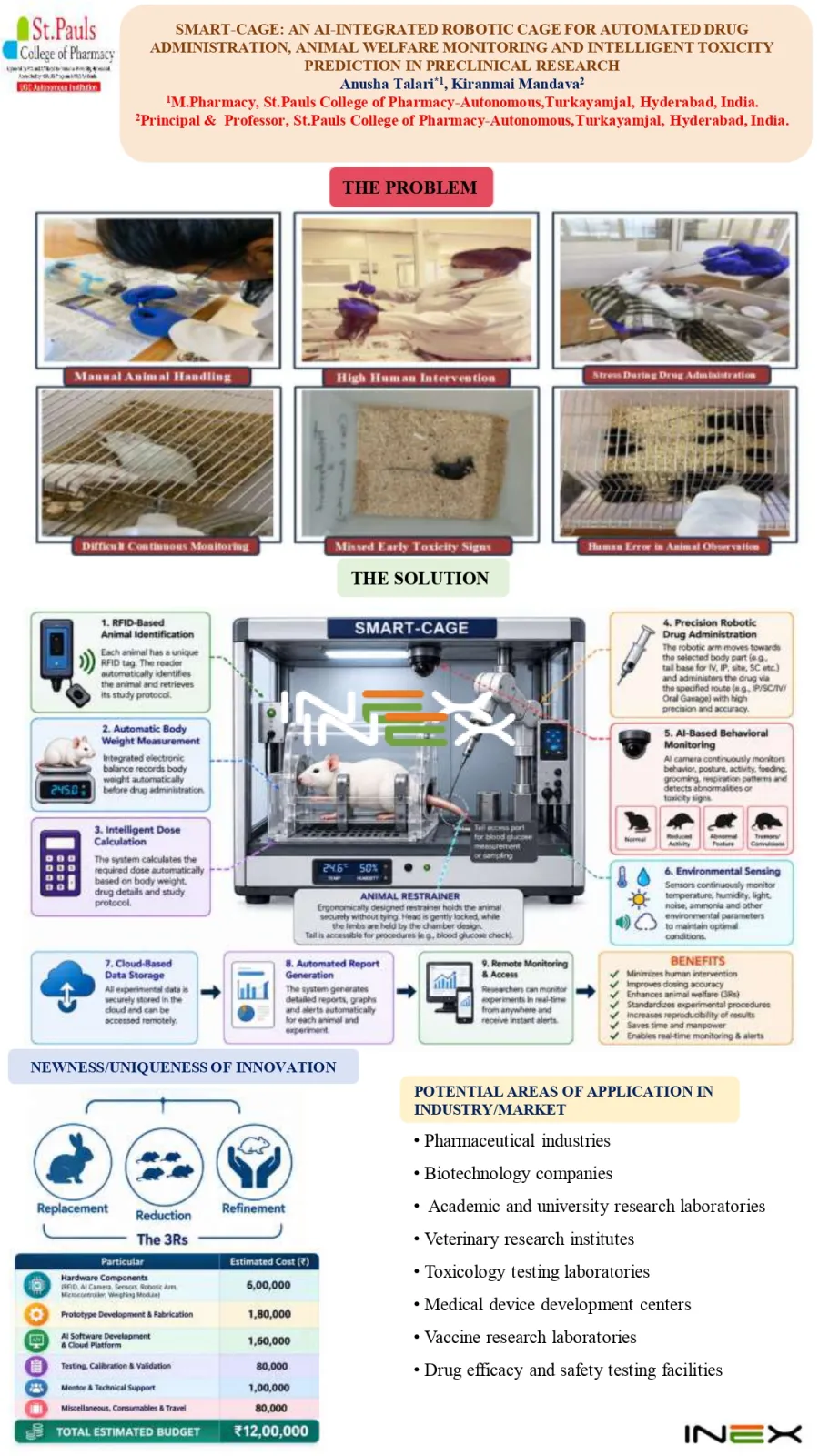
SMART-CAGE: An AI-Integrated Robotic Cage for Automated Drug Administration, Animal Welfare Monitoring and Intelligent Toxicity Prediction in Preclinical Research
Young InnovatorsSMART-CAGE is an AI-integrated robotic animal research platform designed to automate animal identification, body-weight measurement, protocol-based drug-dose calculation and administration, and continuous behavioural and health monitoring. By integrating RFID, robotics, AI and IoT technologies, it aims to reduce repetitive manual handling, improve experimental traceability, support animal welfare and enable early identification of potential toxicity signals in preclinical research.
- Innovator(s)
- Talari Anusha, Dr. Kiranmai Mandava
- Organisation
- St. Pauls College of Pharmacy
- Country
- India
- Exhibition zone
- Idea Street
- Technology Readiness Level
- TRL 2 of 9
- Edition
- INEX 2026
About this innovation
Introduction
Preclinical animal studies are essential for evaluating drug safety and efficacy. However, conventional laboratory procedures often involve manual animal identification, weighing, dose calculation, drug administration, behavioural observation and record keeping. These repetitive activities can increase researcher workload, handling-related stress, dosing variability and the possibility of delayed identification of abnormal behavioural or health changes.
Proposed Innovation
SMART-CAGE is a proposed AI-integrated robotic rodent cage that combines artificial intelligence, robotics, RFID and IoT technologies into a single supervised research platform.
Major Features
1. RFID-Based Animal Identification: Automatically identifies individual animals and links them to their respective study records.
2. Automatic Body-Weight Measurement: Measures and records animal body weight using an integrated weighing module.
3. Intelligent Dose Calculation: Calculates protocol-defined drug doses based on verified body weight and researcher-approved study protocols.
4. Robotic Drug Administration: A robotic mechanism designed to administer drugs through a selected route, initially focusing on one validated administration route.
5. AI-Based Behavioural Monitoring: Uses cameras and AI algorithms to monitor movement, activity, posture and behavioural changes.
6. Physiological and Environmental Monitoring: Integrates suitable sensors to monitor selected physiological and environmental parameters.
7. Intelligent Toxicity Alerts: Identifies abnormal patterns that may indicate possible toxicity or distress and alerts researchers for further assessment.
8. Cloud-Based Data Management: Maintains time-stamped digital records, automated reports and secure data storage.
Working Principle
The workflow begins when an animal enters the SMART-CAGE chamber. RFID verifies its identity, followed by body-weight measurement and protocol-based dose calculation. After safety checks and researcher authorization, the robotic module performs the selected drug-administration procedure. AI-supported cameras and sensors continuously collect relevant behavioural and health information. The software processes these observations, flags abnormalities for human review, generates digital reports and stores experimental records. Finally, the animal returns to its home cage.
Innovation and Uniqueness
The key innovation is the integration of animal identification, weighing, dose calculation, drug administration, behavioural monitoring and digital documentation into one connected platform. Unlike fragmented manual workflows, SMART-CAGE aims to link individual animal records with dosing and subsequent observations.
Expected Benefits
1. Reduces repetitive manual work and unnecessary animal handling.
2. Supports consistent, protocol-based drug administration.
3. Improves experimental traceability and documentation.
4. Supports continuous behavioural monitoring.
5. Enables early alerts for potential toxicity or distress.
6. Promotes animal-welfare refinement in accordance with the 3Rs principles: Replacement, Reduction and Refinement.
Potential Applications
Pharmaceutical industries, biotechnology companies, contract research organizations, academic research laboratories, veterinary research institutes, toxicology laboratories and drug-development centres.
Development Status
SMART-CAGE is currently at the idea/concept and preliminary system-design stage. The proposed next steps include prototype fabrication, subsystem integration, calibration, bench testing and controlled validation under appropriate ethical and institutional approvals.
Future Vision
SMART-CAGE aims to transform conventional preclinical animal research into a more automated, intelligent, traceable and welfare-conscious research environment.