COQ10-BASED MAB NANOPARTICLES: NEXT-GEN PLATFORM FOR TARGETED BREAST CANCER DRUG DELIVERY – SMART NANO BULLET
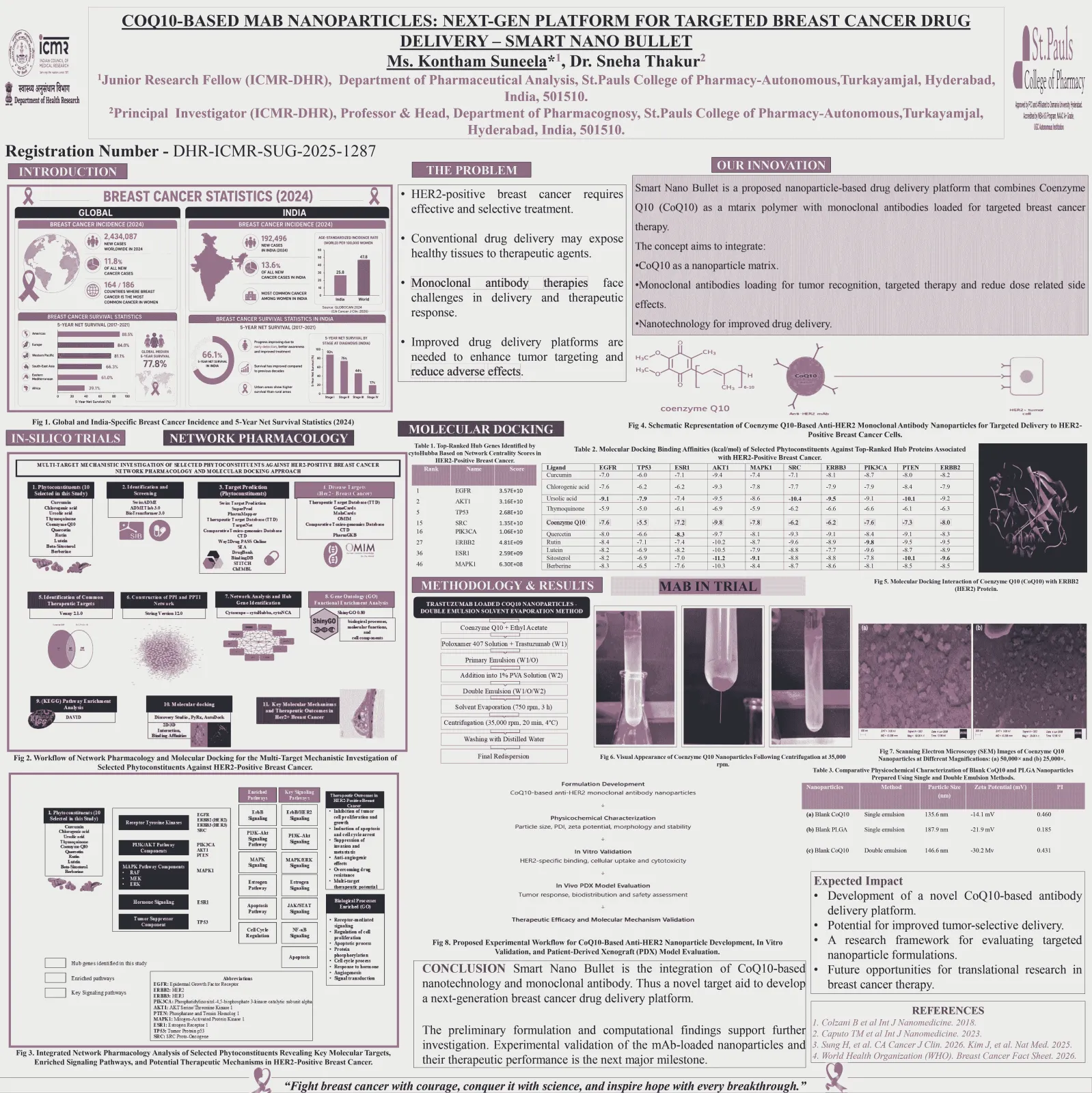
Industry 4.0Our Innovation presents “smart nano bullet,” a proposed CoQ10-based nanoparticle platform for targeted drug delivery in HER2-positive breast cancer. Coenzyme Q10 is used as the nanoparticle matrix, while monoclonal antibodies are intended to help recognize and target breast cancer cells. The study combines network pharmacology, molecular docking, and preliminary characterization of blank nanoparticles to support further development of the platform. The overall aim is to improve tumor-selective
- Innovator(s)
- Ms. Kontham Suneela, Dr. Sneha Thakur
- Organisation
- St. Pauls College of Pharmacy
- Country
- India
- Exhibition zone
- Idea Street
- Technology Readiness Level
- TRL 2 of 9
- Edition
- INEX 2026
About this innovation
Breast cancer, particularly HER2-positive breast cancer, requires effective and selective treatment approaches. Conventional drug delivery may expose healthy tissues to therapeutic agents, while monoclonal antibody therapies can face challenges related to delivery and therapeutic response. This innovation proposes “smart nano bullet,” a next-generation drug-delivery concept that combines CoQ10-based nanotechnology with monoclonal antibody targeting.
In the proposed platform, Coenzyme Q10 (CoQ10) serves as the nanoparticle matrix material, and monoclonal antibodies are intended to support recognition and targeted delivery to breast cancer cells. The concept aims to improve tumor-selective delivery and reduce dose-related adverse effects. It is presented as a proposed platform for further research, not as a clinically validated treatment.
Network pharmacology was used to investigate potential molecular targets and pathways associated with her2-positive breast cancer. Identifies EGFR, AKT1, TP53, SRC, PIK3CA, ERBB2, ESR1, and MAPK1 among the top-ranked hub genes. Molecular docking was also performed to examine the binding interactions of selected phytoconstituents and CoQ10 with target proteins. these computational findings can help guide further investigation, but do not establish therapeutic efficacy.
Preliminary physicochemical characterization was carried out using blank CoQ10 and PLGA nanoparticles prepared by single- and double-emulsion methods. The reported particle sizes were 135.6 nm for blank coq10 prepared by single emulsion, 146.6 nm for blank CoQ10 prepared by double emulsion, and 187.9 nm for blank PLGA prepared by single emulsion. Concludes that the preliminary formulation and computational findings support continued investigation. The next major steps are to validate the mAb-loaded nanoparticles experimentally and assess their therapeutic performance, including through the proposed in vitro and patient-derived xenograft evaluation workflow.