Integrated Pilot-Scale Biodigester for Co-digestion of Cow Dung and Sheep Litter and Production of Biofertilizer for Mushroom Cultivation
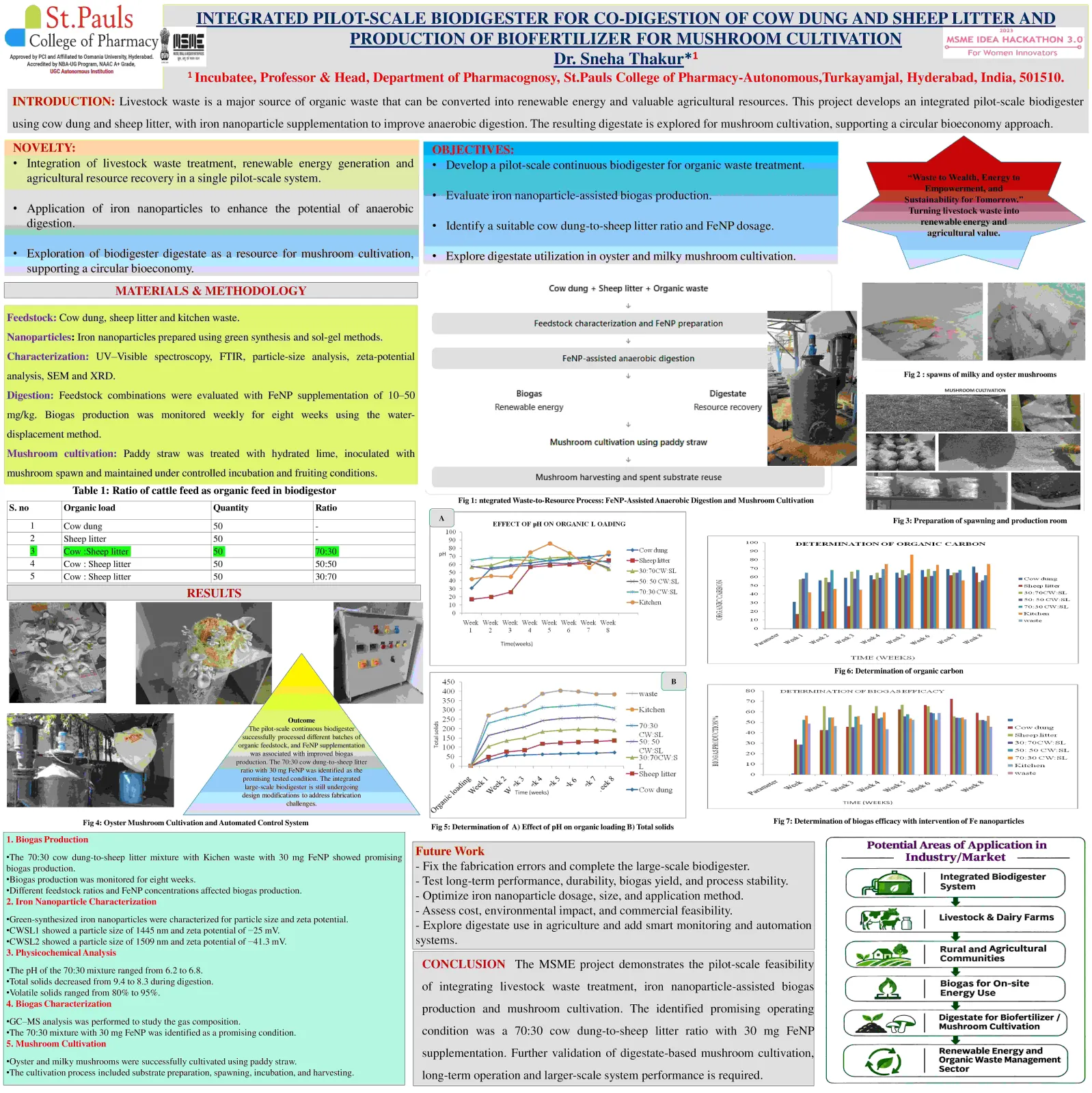
Industry 4.0The integrated pilot-scale biodigester converts cow dung and sheep litter into biogas and nutrient-rich digestate. Iron nanoparticles (FeNPs) are added to enhance digestion efficiency. The digestate is explored as a biofertilizer for mushroom cultivation using paddy straw substrate. This integrated approach promotes waste management, renewable energy generation, sustainable mushroom production, and additional income.
- Innovator(s)
- Dr. Sneha Thakur
- Organisation
- St. Pauls College of Pharmacy
- Country
- India
- Exhibition zone
- Product Arena
- Technology Readiness Level
- TRL 5 of 9
- Edition
- INEX 2026
About this innovation
1. The project focuses on developing a pilot-scale integrated biodigester designed to convert cow dung, sheep litter, and other organic wastes into biogas and digestate, which can be utilized in agriculture. This initiative aims to enhance anaerobic digestion efficiency through the treatment of iron nanoparticles (FeNP) and to explore the potential of using biodigester waste for mushroom cultivation. The biodigester is designed with a capacity of 50-100 kg, following a continuous digestion approach, and aligns with a circular bioeconomy model that diverts organic waste from landfills, transforming it into valuable resources while integrating livestock waste management, renewable energy generation, and mushroom production. The project began with the collection and characterization of potential feedstocks, including dairy and sheep litter, as well as kitchen waste. A thorough analysis was conducted to assess their suitability for anaerobic digestion, evaluating parameters such as pH, total solids, volatile solids, organic carbon, nitrogen content, carbon-to-nitrogen ratio, and total volatile fatty acids. The initial characterization revealed promising feedstock compositions for biogas production, particularly through various combinations of cow dung and sheep litter, such as ratios of 30:70, 50:50, and 70:30. The project also investigated the synthesis and characterization of iron nanoparticles, employing two methods: green synthesis using kitchen waste and a sol-gel method. The green synthesis involved extracting vegetable peels like potato, onion, tomato, and carrot, which were then mixed with an iron precursor to form nanoparticles, while the sol-gel method involved dissolving an iron precursor in distilled water with a gelling agent. Characterization techniques, including UV-Visible spectroscopy, FTIR, particle-size analysis, zeta-potential analysis, SEM, and XRD, were employed to analyze the optical properties, chemical characteristics, particle morphology, size, surface stability, and crystalline structure of the nanoparticles. The biodigester was tested with various feedstock combinations, and biogas production was monitored weekly over eight weeks, measuring parameters such as pH, total solids, volatile solids, organic carbon, and biogas yield using the water-displacement method. The study found that the addition of iron nanoparticles at varying amounts (10 to 50 mg/kg of feedstock) improved biogas production, with the 30 mg dosage and a 70:30 cow dung-to-sheep litter ratio yielding the best results. Gas chromatography-mass spectrometry (GC-MS) was utilized to characterize the gas produced from selected feed mixtures. The results indicated that biogas production was influenced by feedstock composition and digestion duration, with specific values recorded for different mixtures. The project also explored the use of biodigester waste as a substrate for mushroom cultivation, specifically focusing on oyster and milky mushrooms. The cultivation process involved using paddy straw as the substrate, which was treated with hydrated lime and then layered with mushroom spawn in clean plastic bags. The spawning room was maintained at optimal temperature and humidity levels, and after colonization, the bags were transferred to a production room for controlled growth conditions. Although the workflow for mushroom cultivation was established, the report noted a lack of quantitative data to compare the yield and quality of mushrooms grown with biodigester digestate versus untreated controls, indicating the need for further trials and nutrient analysis. Key achievements outlined in the progress report included the characterization of feedstock, assessment of feedstock ratios, preparation of iron nanoparticles, evaluation of nanoparticle-assisted digestion, monitoring of biogas production, standardization of mushroom cultivation procedures, and pilot-scale demonstration of the biodigester concept. However, challenges were encountered regarding the operational feasibility and fabrication of a larger integrated biodigester system, necessitating further engineering adjustments to enhance its effectiveness. Future work will focus on demonstrating long-term continuous operation, quantifying biogas composition and yield, optimizing feedstock loading and nanoparticle dosage, and validating the nutrient value of digestate for agricultural use. Controlled comparisons of digestate-treated versus untreated cultivation systems for mushrooms are also recommended. The report suggests several next steps, including the installation of a control panel for improved operational management, demonstrating the consistency of biodigester waste as fertilizer, evaluating biogas production with optimized feedstock combinations, and designing a deodorizing system to mitigate odors from the biodigester. These activities aim to address current engineering limitations and enhance the system for further validation at the pilot scale. The project holds significant social and environmental implications, offering an integrated waste-to-resource solution for dairy farms, livestock units, rural enterprises, and mushroom growers. Its anticipated benefits include better livestock waste management, renewable energy generation, recovery of organic resources, and opportunities for value addition through mushroom cultivation. By incorporating circular economy principles, the project links livestock waste, biogas generation, digestate reuse, and mushroom production into a cohesive system. If the remaining engineering, safety, and performance requirements are met, this technology could serve as a practical model for decentralized organic waste management and rural enterprise development. In conclusion, the progress report indicates the pilot-scale feasibility of a continuous biodigester concept for processing cow dung, sheep litter, and other organic feedstocks, with iron nanoparticle treatment showing promise in enhancing biogas production. The identified optimal conditions include a 70:30 cow dung-to-sheep litter ratio with 30 mg FeNP treatment. The project has also developed a protocol for cultivating oyster and milky mushrooms using treated paddy straw and is investigating the agricultural applications of biodigester waste. Remaining tasks involve resolving fabrication issues and completing the integrated larger-scale system, including control and odor management components. Standardized performance testing and controlled trials for fertilizer and mushroom cultivation will be crucial for validating claims regarding commercial-scale efficiency, digestate effectiveness, and economic benefits. Overall, the project represents a promising initiative for transforming waste into wealth by integrating livestock waste management, renewable energy generation, and mushroom cultivation, with further engineering development and validation required for successful scale-up and commercialization.